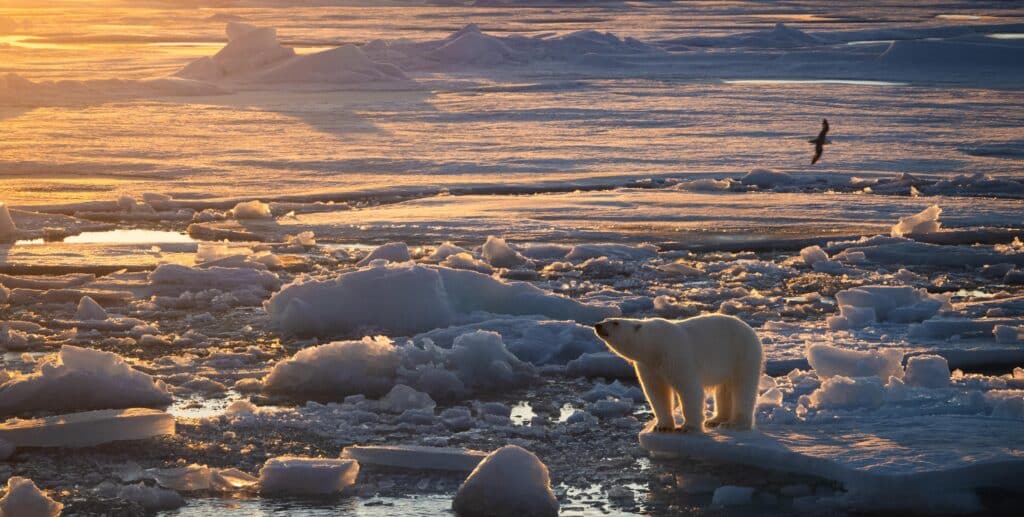
The population of polar bears on the Norwegian archipelago of Svalbard has maintained a stable—and even improved—body condition over the last two decades, contrary to the trend observed in other areas of the Arctic. The conclusion comes from a study now published in the scientific journal Scientific Reports, which analyzed data collected between 1992 and 2019.
The researchers assessed more than 1,100 records of body measurements from about 770 adult polar bears, using a body-condition index that estimates fat reserves and the animals’ overall condition. The results show that, although the Barents Sea region has lost sea ice at a particularly high rate—with an increase of about 100 days without ice over 27 years—the average body condition of the bears improved from the early 2000s.
This result is surprising, especially because Svalbard lost sea ice at more than double the speed recorded in other areas inhabited by polar bears. In much of the Arctic, the reduction of ice has been associated with population declines and with the worsening physical condition of these animals, which are heavily dependent on ice to hunt.
The authors of the study point to several hypotheses to explain this resilience. One is the recovery of terrestrial prey previously overexploited by humans, such as reindeer and walruses, which have become more available. Another possibility is that in years with less ice, ringed seals — one of the polar bears’ main prey — concentrate in smaller areas, making hunting more efficient.
Despite the positive data, the researchers warn that this scenario may not persist. The continuation of sea ice loss could force the bears to travel greater distances to reach hunting areas, a phenomenon already observed in other Arctic populations, with known negative impacts.
The study thus emphasizes the importance of not assuming that all animal populations will respond in the same way to climate change, while reinforcing the need for more research to understand how different groups of polar bears may adapt to an Arctic that is becoming increasingly warm.