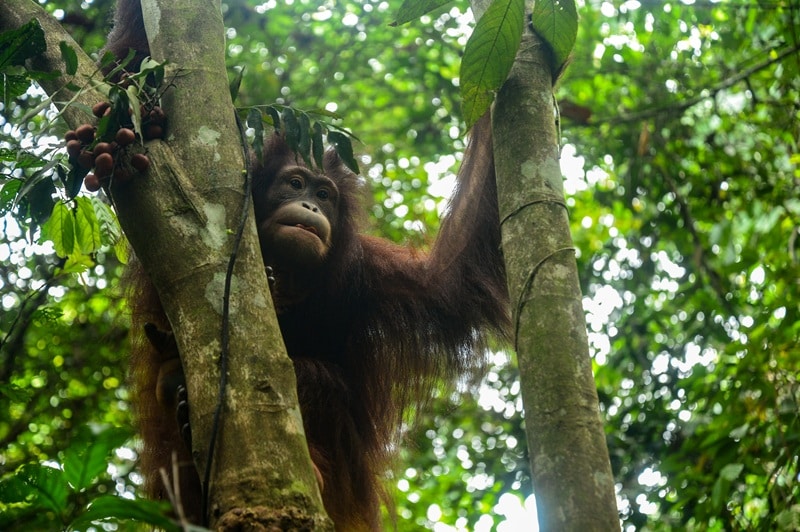
Rescued in 2016 from illegal captivity, Popi, a female orangutan, is back in her natural habitat, in the lush tropical forest of Busang, in East Kalimantan province, in the Indonesian region of the island of Borneo.
Popi’s story did not have a happy beginning. According to The Orangutan Project, Popi was confiscated nine years ago from a family in the village of Sempayau, in East Kalimantan, near a commercial palm oil plantation. She was being kept illegally, and it is believed that her mother was killed and that her offspring was sold as a pet.
Popi was only eight weeks old, toothless, and cried constantly, presumably because she missed her mother, whom orangutans of that age are entirely dependent on for food, comfort, and protection.
The rescue was carried out by a team from the Borneo Orangutan Rescue Alliance (BORA), a partnership between The Orangutan Project, the Indonesian Ministry of Environment and Forestry, and the Center for Orangutan Protection, a local organization dedicated to fighting forest destruction in that country and to the conservation of these great primates.
Orangutans are under strong threat on the islands of Borneo and Sumatra, the only places where they still exist in the wild. Deforestation, the expansion of palm oil plantations, hunting, and trafficking have been driving these animals closer and closer to the brink of extinction.
All three recognized species of orangutan—the Bornean orangutan (Pongo pygmaeus), the Sumatran orangutan (Pongo abelii), and the Tapanuli orangutan (Pongo tapanuliensis)—are classified as “Critically Endangered” on the IUCN Red List of Threatened Species.
Popi’s life is merely a reflection of the harsh trials faced by this group of primates.
At the heart of BORA, in East Kalimantan, the young infant was under careful and constant care from a “surrogate mother,” a human, to provide her with everything her orangutan mother would have provided in the wild.
Integrated into what can be described as a kind of “creche,” Popi learned to become a true orangutan and eventually formed a strong bond with another orphan, named Happi. According to The Orangutan Project, Popi and Happi became inseparable, playing, exploring, and even sleeping together, clinging to each other. “These bonds are vital for the emotional recovery and for the social development of young orphans,” explains the organization.
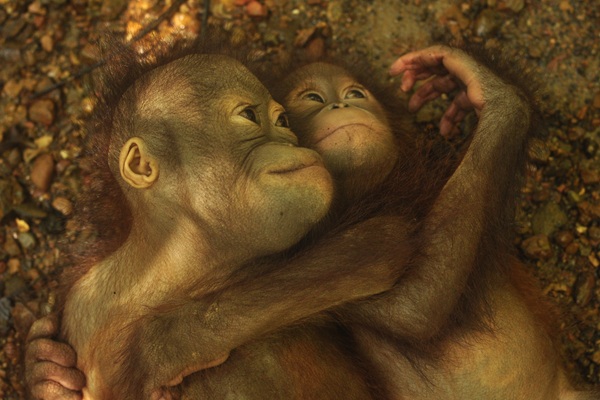
Those who worked most closely with her described Popi as gentle, with a very expressive face, who loved playing in streams and sometimes struck “dramatic poses” for the cameras.
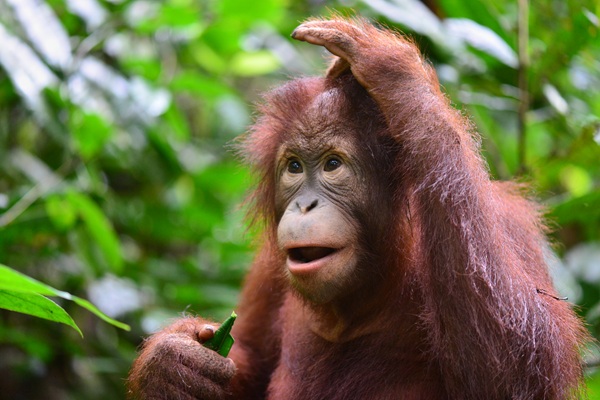
In May 2025, after years of learning, growth, and recovery, Popi was transferred to acclimatization facilities, a crucial first step in the process of returning to the wild, where she continued to refine her survival skills, such as foraging for food, nest-building, tree climbing, and strengthening her body.
Finally, on August 10, at about nine years of age, she arrived at what will be her permanent home, in the tropical forest of the Busang Ecosystem, in eastern Borneo, which serves as a sanctuary for rehabilitated orangutans that have been reintroduced into their natural habitat.
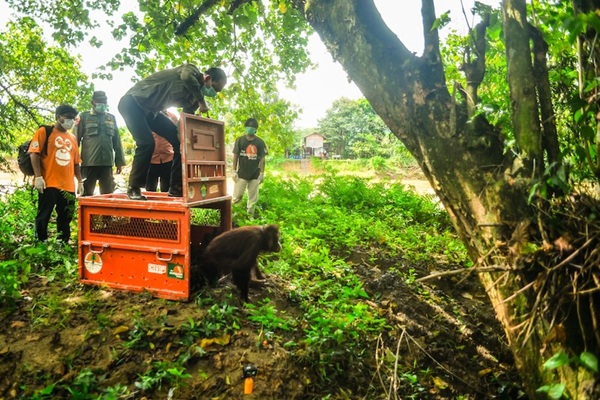
When the door of the crate in which she had been transported was opened, after a journey of several hours by car and boat, Popi sprang toward a tree and immediately began to scramble to the top.
The Orangutan Project says that the following day Popi reconnected with her friends Mary and Bonti, who had been released in January. “What a privilege it is to see Popi living in the wild and free, surrounded by friends and thriving in the forest that she should always have called home.”