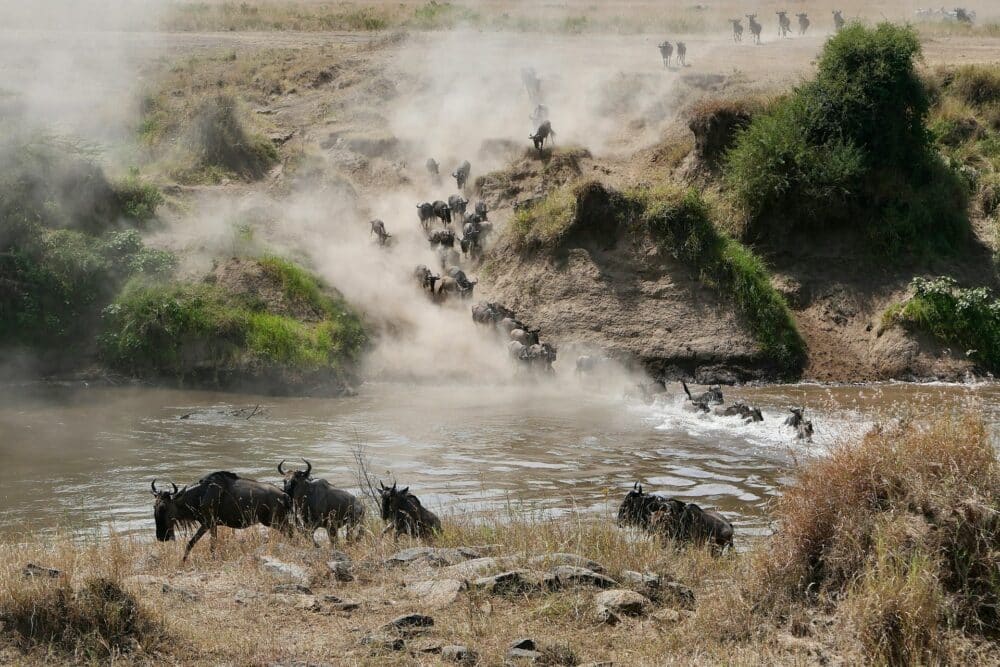
The Great Wildebeest Migration between Tanzania and Kenya, in East Africa, is considered the world’s largest annual terrestrial animal migration currently taking place on the planet. This long journey, which can extend up to 1,600 kilometres in a circular route, is essential for the ongoing regeneration of ecosystems.
Estimates pointed, based on aerial imagery captured from helicopters or small planes, that one of the most fascinating phenomena in the natural world moves around 1.3 million animals, a number that has remained virtually unchanged since the 1970s.
However, a group of scientists believes that these methods do not allow for a truly accurate idea of how many wildebeest participate in the Great Migration, because they capture only a small area in a short period of time. The answer, they say, lies in satellites.
According to this international team, satellite images offer a much wider coverage, up to tens of thousands of square kilometres in a single photograph, reduce the margin for repeated counts and avoid the need to extrapolate population sizes based on images that are too limited in space and time.
Of course, counting wildebeests from space is not an easy task, which is why the researchers turned to Artificial Intelligence to help. Thus, using images captured between August 2022 and August 2023 of Serengeti National Park in Tanzania, and Masai Mara National Reserve in southwestern Kenya, they arrived at an estimate of between 533,000 and 324,000 animals, a significant difference compared with the around one million animals of previous estimates.
The conclusions were presented in an article published in the journal PNAS Nexus, and its authors even admit that the numbers they reached may be slightly overestimated, since the satellite images they worked with do not allow them to fully distinguish wildebeest from other animals that often accompany them on the Great Migration, such as zebras and elands.
The scientists say that the large discrepancy between one estimate and another, a difference of almost half, does not mean that wildebeest populations are collapsing, but that extrapolated counts may have greatly inflated the real size.
Nevertheless, they warn that wildebeests are under great pressure. The fragmentation and destruction of their habitat, especially due to agricultural expansion, infrastructure development and the placement of fences, are reducing the space available for the migration of these animals, as well as of others. On the other hand, climate change is altering the pace of rains and reducing the abundance of pastures on which wildebeest and other migratory herbivores depend to survive.
As such, this group of researchers says that it is precisely for this reason that more accurate population counts are essential to strengthen and make conservation actions more effective.