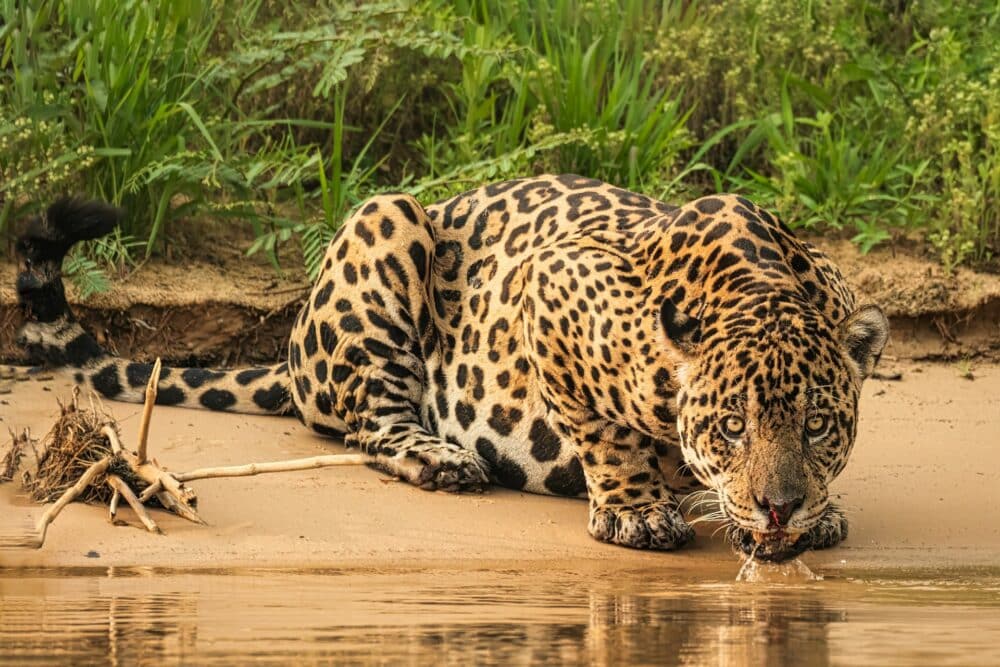
A jaguar (Panthera onca) swam at least 1.27 kilometers in uninterrupted swimming across the Serra da Mesa Hydroelectric Plant reservoir, in the northern part of Goiás state, Brazil.
The animal, an adult male, swam from the lake’s edge to a small island, although the reason that led it to cover such a distance remains unknown, the longest ever recorded for the species. The previous record was about 200 meters, so the new distance is roughly six times greater.
The moment was captured on August 8, 2024 by cameras installed four years earlier in the area by biologists, and documented in an article published in bioRxiv. However, scientists, from the Onça-Pintada Institute, the University of Brasília and the National Institute for the Atlantic Forest, admit that the distance may have been even greater.
The estimate included an even smaller islet along what is assumed to be the path followed by the jaguar to the island that ultimately became its final destination. If the animal paused on the islet before continuing, the swim divides into two moments: one of about 1.06 km from the shore to the islet and another of 1.27 km from the islet to the final island. However, if the animal swam in one go, without pauses, the total distance rounds to about 2.48 km.
The estimate advanced by the researchers is based on the more conservative scenario, that of a pause, but they do not reject the hypothesis that the jaguar swam without stopping.
Whichever route was followed, this large feline shattered all scientifically documented records of uninterrupted swimming crossings by jaguars, animals known to be excellent swimmers and to even hunt caimans in the water, laying to rest the old adage that no cat likes to get wet.
The scientists argue, in the paper, that this case shows that large bodies of water, such as reservoirs, do not function as “absolute barriers to the movement of carnivores,” and can continue to be crossed by them, albeit with substantial additional energy costs.