A study led by scientists from the Queensland Museum Tropics and James Cook University in Australia, in collaboration with international researchers, has resolved a scientific enigma spanning almost two centuries and led to the identification of a new species, a new genus, and an entirely new family of soft corals.
The research, published in the scientific journal Invertebrate Systematics, has reformulated the classification of soft corals across the Indo-Pacific region, a highly diverse group but historically understudied when compared with reef-building hard corals.
Unlike hard corals, soft corals do not have a rigid calcium carbonate skeleton. Although they are abundant on reefs such as the Great Barrier Reef, their diversity and evolutionary relationships have, for decades, been a source of scientific confusion.
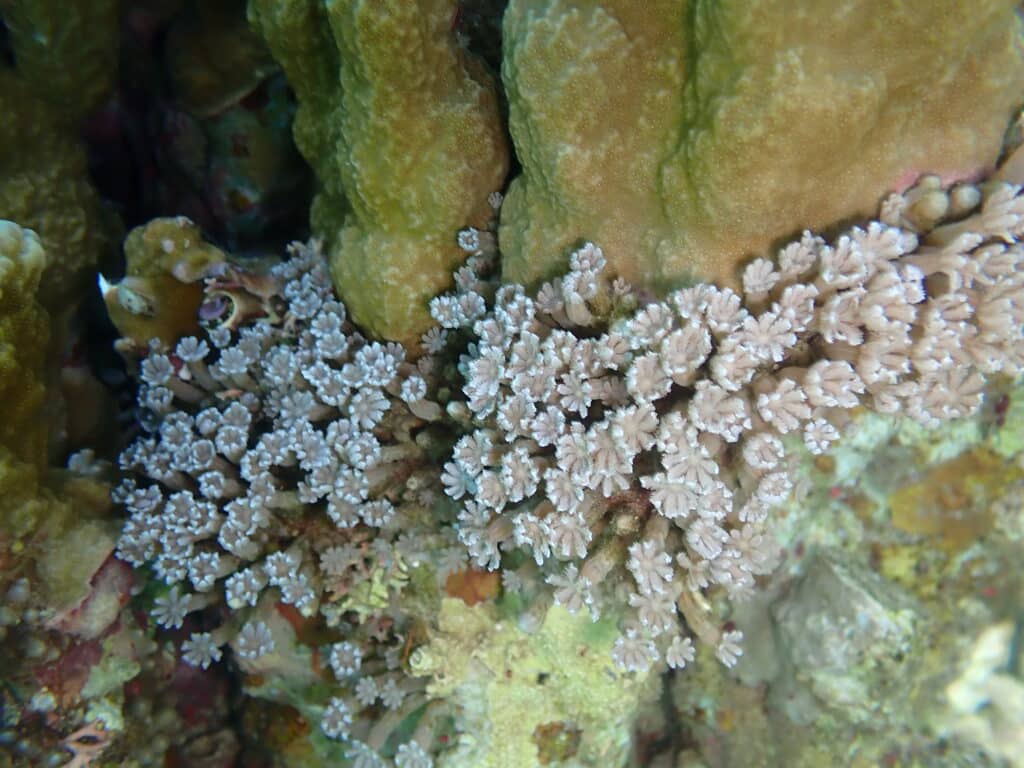
The study revisited the genus Clavularia, first described in 1830. To clarify its true position on the tree of life, the researchers combined modern genetic analysis techniques with a meticulous re-examination of historical museum specimens preserved in Europe and Australia.
One of the most relevant aspects of the work was the analysis of the so-called type specimens (holotypes) — the original specimens used to formally describe each species in the nineteenth and twentieth centuries, regarded as the ultimate reference for biological classification.
Among the main discoveries is the description of a hitherto unknown species to science, Clavularia brunafolia, found exclusively on the Great Barrier Reef, currently the only known species of this genus restricted to this region.
The team also identified a new genus and species in Japan, Bairdium iriomotejimaensis, as well as a new family of soft corals, Hicksoniidae, which includes species found in Western Australia and Japan.
The study’s lead investigator, Stefano Borghi, collection manager at the Queensland Museum Tropics and a PhD student at James Cook University, underscores the importance of the work for understanding marine biodiversity. “For nearly two centuries, the name Clavularia was used without knowing exactly which original species it referred to. It was a genuine case archived by science,” he says.
“By locating the original specimens in European museums and applying modern genetic techniques to material preserved for more than a century, we have finally corrected the evolutionary tree of soft corals,” he adds.
One of the study’s greatest technical feats was the extraction and sequencing of DNA from a specimen collected in Indonesia in 1899, preserved for more than 125 years. For Peter Cowman, the Queensland Museum Tropics’ senior scientist for marine biodiversity and co-author of the study, this advance represents a decisive shift in marine taxonomy research.
“Obtaining genetic information from a specimen preserved since the Victorian era is extremely rare,” he explains. “It allows us to confirm with precision what nineteenth-century scientists observed, linking historical discoveries to twenty-first-century technology.”
The authors argue that the results show that many species previously regarded as broadly distributed are, in fact, far more specific and rare than previously thought, revealing a significantly underestimated diversity on tropical reefs.