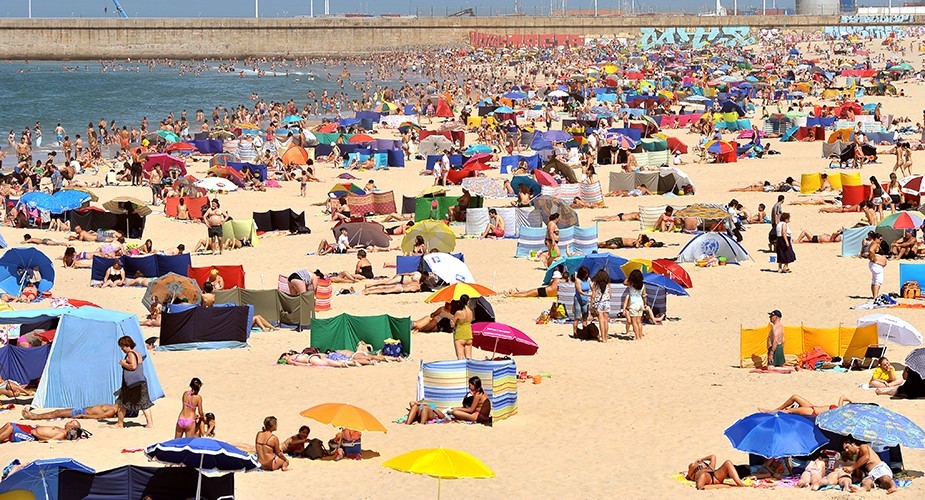
The Matosinhos beach, in the Porto district, is at risk of not being considered a bathing area, with immediate measures expected from the City Council, revealed yesterday by the president of the Portuguese Environment Agency (APA).
The issue at stake are the high pollution levels and the risk to public health at one of the country’s most frequented beaches, which records up to 14,000 users per day in the summer and which was closed 18 times during the last bathing season.
“It is one of the beaches for which we are currently awaiting a set of measures to minimize pollution. As is known, in the past this was the beach that had several pollution episodes that led to its closure. Therefore, obviously, this year, in addition to the measures that were provided, we are asking for more measures to assess the situation,” said the president of the APA’s board of directors.
In statements to the Lusa agency, José Pimenta Machado referred that the public consultation process runs until February 2 and the final decision will be made in April and he confirmed that this is the only one of Portugal’s 370 mainland beaches with this risk.
“We will wait for the City Hall to carry out this work and we are, naturally, collaborating with the health authority. We hope they bring measures to control and minimize the effect of pollution at Matosinhos Beach,” added the official, revealing that a meeting with the socialist-led city council headed by Luísa Salgueiro has been scheduled for next week.
“But if these measures are not enough, then it may be a beach that will not be a bathing beach,” he pointed out.
The Lusa agency contacted the Matosinhos City Hall, which referred clarifications to the APA.
To Lusa, José Pimenta Machado highlighted some of the measures already underway, namely a project by the Faculty of Engineering of the University of Porto on the Ribeira da Riguinha, as well as one on Avenida D. Afonso Henriques that involves works already scheduled for the next month to intervene in sanitation in order to minimize and eliminate illegal connections.
“We know that this stream greatly conditions the beach’s quality. The municipality has projects there, for the Real area as well, so we will wait for next week’s meeting and evaluate. We know that seagulls also greatly condition it,” described the president of the APA.
In an interview with RTP on this topic, Adriano Bordalo e Sá, a researcher at the Abel Salazar Biomedical Sciences Institute (ICBAS), revealed that the effects of bacteria caused by seagulls can be, in the most vulnerable, diarrhea and skin, eye and ear problems.
The team of this researcher installed a seaside laboratory with sampling every 30 minutes over the last two summers and confirmed the lack of water quality and the streams that drain into the beach, namely the consequences of the 800 illegal connections originating from Ribeira da Riguinha.