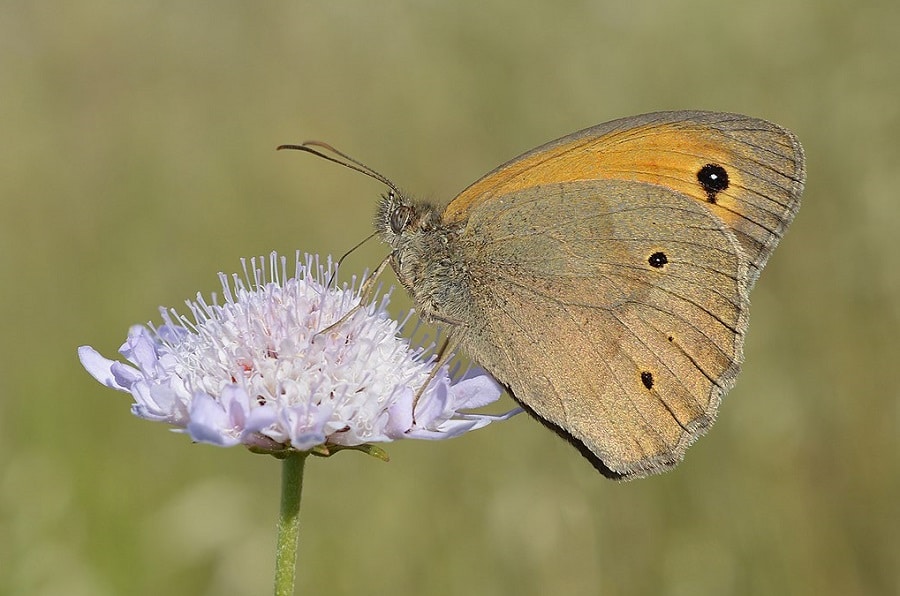
As the planet’s temperature rises, the meadow brown butterflies (Maniola jurtina) are losing the dark spots on their wings. It is thought that the eye-like spots on the forewings serve to deter predators, and that the smaller spots on the hindwings are used as a camouflage mechanism.
Photo: Richard ffrench-Constant
A study led by the University of Exeter, in the United Kingdom, found that females of this butterfly species that develop at an ambient temperature of 11 degrees Celsius have six spots on the underside of the hindwings. However, those that develop at higher temperatures have fewer spots.

Photo: Richard ffrench-Constant
The results of the study were published in a paper in the Ecology and Evolution journal. Richard ffrench-Constant, one of the lead authors, explains in a press release that “fewer and fewer of these spots on the hindwings appear when the females experience higher temperatures during the pupal stage,” a developmental stage in which the future butterfly is enclosed in a chrysalis.
In addition to the loss of spots on the hindwings, the scientists also found females that lost the large eye-shaped spots on the forewings.
Photo: Richard ffrench-Constant
Based on these findings, the researcher argues that “this suggests that the butterflies adjust their camouflage according to the conditions,” detailing that “with fewer spots they may be harder to detect in the dry, brownish grass that would be more common in a hotter climate.”
However, the same was not observed in males, and the team believes this may be due to the spots playing an important role in reproduction, in attracting females.
Until now, it was thought that variations in the spots on the meadow brown butterflies’ wings within a single population reflected what is known as genetic polymorphism, i.e., “the coexistence of multiple genetic forms within the same population.” But this study reveals that, in fact, the differences arise from a ‘thermal plasticity’, a capacity by which butterflies respond to and adapt to temperature changes in the environments in which they develop.
With a planet growing hotter, researchers predict that the spots on female meadow brown butterflies will diminish year after year. And Richard ffrench-Constant admits to being surprised by what they found: “this is an unexpected consequence of climate change,” in which “we tend to think that species move northward, instead of changing their appearance.”