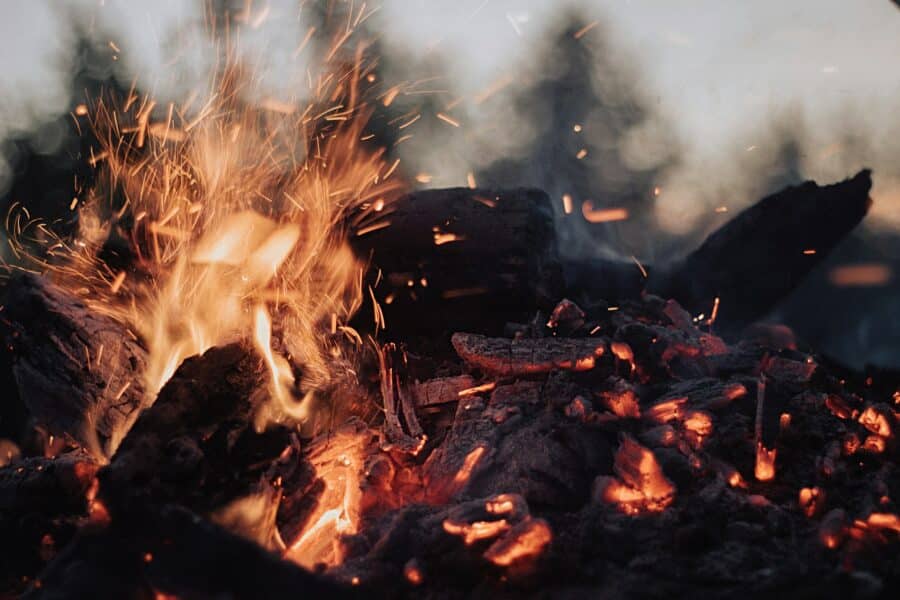
Wildfires and controlled burns in wild areas emit “substantially larger” amounts of pollutant gases and suspended particles than previously estimated, a study published today in the journal Environmental Science & Technology indicates.
Conducted by an international team led by scientists from Tsinghua University in Beijing, China, the investigation concludes that air pollution from wildfires has been underestimated for decades.
“Our new estimates raise emissions of organic compounds from wildfires by about 21%,” says Lyuyin Huang, a researcher at the School of Environment at Tsinghua University and the lead author of the study, cited by the Spanish news agency EFE.
Wildfires release a complex mix of water vapor, ash and carbon-based compounds into the air, with some of these gases referred to as volatile organic compounds (VOCs).
The VOCs that evaporate and transform into gases at higher temperatures are referred to as intermediate- and semi-volatile organic compounds (IVOCs and SVOCs, respectively) and form fine particles (pollutants that can be harmful if inhaled) more readily than the VOCs themselves.
However, according to the work released today, until now most studies that evaluated wildfire emissions have neglected IVOCs and SVOCs due to their large quantities.
The team, led by Shuxiao Wang, from the School of Environment at Tsinghua University, decided to calculate IVOC and SVOC emissions together with VOCs to obtain a better understanding of the impact of wildfires on air quality, health, and climate.
To this end, the researchers drew on a dataset of land area burned by wildfires in forests, grasslands and peatlands, from 1997 to 2023, collecting data on VOCs, IVOCs and SVOCs and other extremely low volatility organic compounds (ELVOCs) emitted when each type of vegetation burns.
For vegetation types without field measurements, scientists relied on laboratory experiments to predict the organic compounds released.
By combining these datasets and calculating annual global emissions, the team estimated that wildfires released an average of 143 million tonnes of organic compounds into the air in each of the studied years, 21% higher than previous estimates indicated.
The study also identifies several regions with high emissions from both wildfires and human-caused fires in equatorial Asia, in the North African countries, and in Southeast Asia.
“The inventory provides a basis for more detailed modeling of air quality, health risk assessment, and analysis of climate-related policies,” says Lyuyin Huang.