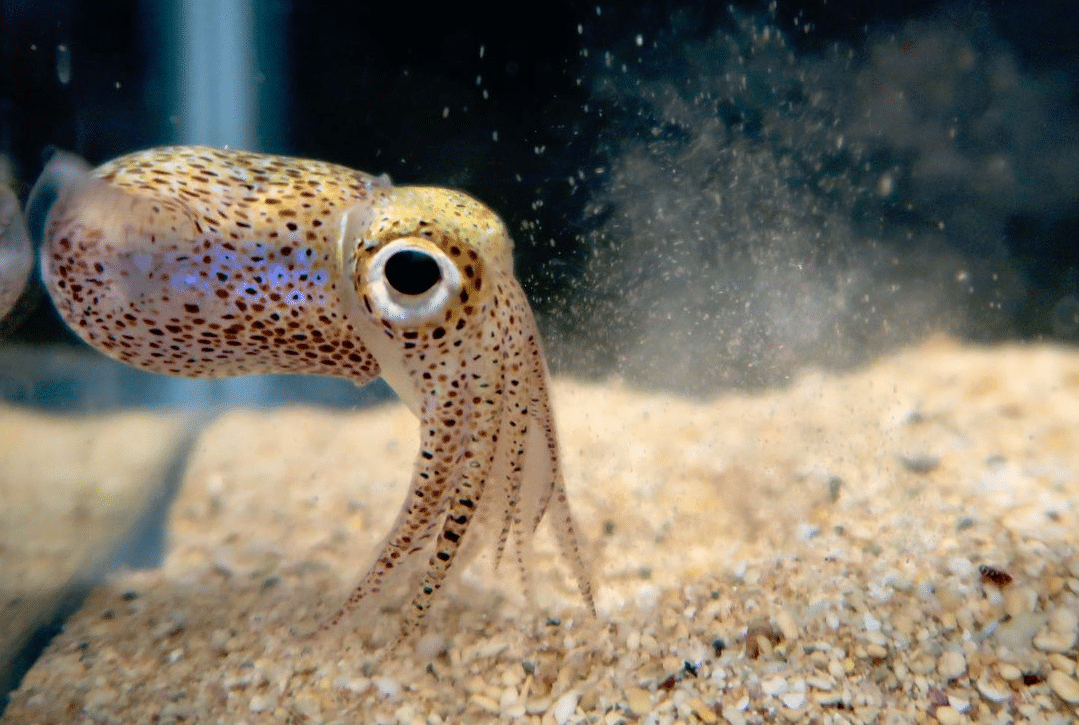
It is called Euprymna scolopes, and it is a small squid, about 3.5 centimeters in length, that lives in the waters around the Hawaiian archipelago.
Like other close relatives, or even as distant as glow-worms, this cephalopod is capable of producing its own light, a phenomenon known as bioluminescence. This capacity results from a “partnership” that the squid forms with luminous bacteria as soon as it hatches. In the hours after they hatch from their eggs, these squids acquire those bacteria and host them in specialized organs, and, later, they use the light produced by the microorganisms to, for example, camouflage themselves at night through counter-illumination.
In a study recently published in the journal Proceedings of the Royal Society B, a team of scientists from the Marine and Environmental Sciences Centre (MARE) of the University of Lisbon and the Centre for Functional Ecology of the University of Coimbra, in collaboration with researchers from other countries, reveals that as the oceans become warmer and more acidic the partnership between the small squid and the luminous bacteria can become compromised. In addition, hatch success may also be put at risk.
In a press release, Eve Otjacques, a researcher from MARE and the study’s first author, explains that this is the first time that a molecular approach has been used to study the effects of warming and acidification of the oceans on this type of cephalopod mollusks.
The team found that marine warming reduces the hatch success of the Euprymna scolopes, but that acidification has an even greater negative effect. Moreover, it was also found that acidification causes changes in genes related to metabolism and energy production in the little squid, and that warming affects the animal’s ability to associate with luminous bacteria.
“It was interesting to discover specific genes that are negatively affected by temperature, which could explain, at the molecular level, the difficulty this animal has in acquiring the luminous symbiotic bacteria at hatching,” explains Eve Otjacques, in a note.
Thus, as climate change advances and its effects are felt in the marine realms as well, the little squid Euprymna scolopes, also known as the bobtail squid, may see its symbiotic partnership with the luminous bacteria threatened and, thereby, its ability to camouflage from predators diminished.