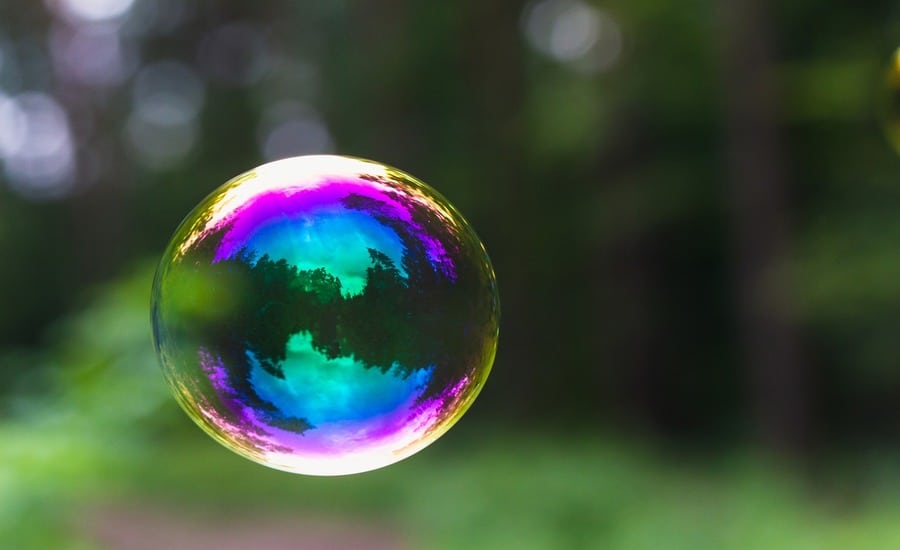
Do you remember the soap bubbles you used to make as a child? And watching their trajectory after you blew, to see how long they could stay afloat in the air? The truth is that bubbles burst in a few seconds, but you wouldn’t expect more than that.
A team of scientists at the University of Lille, in France, created a bubble made of water, glycerol, and small plastic particles, which remained intact for up to 465 days. The bubble lasted more than 200,000 times longer than a normal bubble, and was categorized as the bubble with the greatest longevity produced under normal atmospheric conditions.
For the study, they created three different bubbles and compared their duration until bursting — soap bubbles, water-based gas bubbles, and water- and glycerol-based gas bubbles. As expected, the first ones lasted only about a minute, and the second between 6 and 60 minutes. Thanks to the high concentration of glycerol, the latter managed to stay intact much longer.
As the authors explain, in the case of the soap bubble, gravity causes the liquid to accumulate at the bottom, leaving a thin film at the top that tends to burst easily. In addition, the evaporation of the liquid also makes it less resistant. In the case of the bubble that managed to set the longevity record, the plastic particles maintain the thickness of the bubble, and glycerol absorbs humidity from the air, which ends up neutralizing evaporation, making it more resistant. The group believes that this one burst after microbes had weakened its structure.