

In Europe, around 26 million tonnes of plastic waste are generated every year. Almost half of the plastic collected for recycling is exported outside the European Union, because, it is claimed, there is no capacity in the region to properly process these materials.
Among the main destinations for European plastic are China, Indonesia, the Philippines, Thailand and Vietnam. However, in a recently published article in the journal ‘Circular Economy and Sustainability’, a group of researchers argues that “sending plastic waste to destinations with environmental and social regulations less stringent than those of the EU and with insufficient infrastructure to process plastic waste is socioecologically and ethically questionable”.
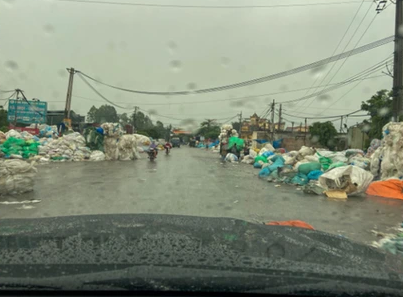
The team traveled to Vietnam, a country where, in 2019, 9% of imported plastic waste came from the EU. There, they visited the largest recycling center in Vietnam, in the village of Minh Khai, where they say they witnessed a troubling reality that illustrates the ‘dark side’ of the waste market.
In a statement, Kaustubh Thapa, a researcher at Utrecht University (Netherlands) and the first author of the article, reveals that they saw “people cooking, eating and living inside the recycling facility, surrounded by the toxic fumes” that emanate from the melting of the plastic.
Due to looser environmental rules, compared to those in force in the EU, for example, the scientists estimate that seven million litres of “toxic wastewater” used in the processing of plastic waste are discharged every day into the rivers and streams in the village.
Furthermore, a significant portion of European plastic, because recycling plants do not have the capacity to respond to the quantity, ends up being discarded into the environment, with the authors writing in the article that “exporting plastic increases the recycling rate in the EU at a significantly lower price than recycling in the EU, but at the cost of questionable facilities and practices that harm workers and their environment”.
“Although this waste trade is lucrative for some, transferring the responsibility for waste management to villages like this harms people, communities and the environment,” warns Kaustubh Thapa, who highlights that “increasing recycling rates in the EU without systematically addressing the human and environmental damages along the entire value chain is neither ethical, nor circular, nor sustainable”.
The author stresses that “the absence of accountability of the players in the value chain, coupled with inadequate implementation of EU and Vietnam policies and a widespread lack of transparency in practices” results in risks to the environment and to human health, both individually and collectively.
For him, European consumers’ recycling efforts, in the current state of affairs and taking what is happening in Vietnam as an example, “are, to a considerable extent, in vain.”
Remembering that only one third of plastic waste is actually recycled in Europe and that rising consumption levels will generate more waste, the researchers call for reducing unnecessary consumption, as well as the production of waste associated with it, and suggest “a shorter, more transparent, more accountable and more ethical value chain,” which promotes “social and environmental equity and global justice, or, at least, does not contribute to inequality and injustice.”