A group of researchers led by the Interdisciplinary Centre for Marine and Environmental Research (CIIMAR) has developed an effective and non-toxic product to remove bacteria, algae and invertebrates that have colonized submerged surfaces, such as ship hulls, port infrastructures and aquaculture equipment.
This colonization phenomenon, known as marine biofouling, or biofouling in English, represents one of the greatest operational and economic challenges for the marine industries, notably the shipping industry, increasing maintenance costs of ships, fuel consumption and emissions.
Currently, the main response to this problem is the use of paints that continuously release toxic substances, such as copper and other metallic compounds, to prevent fouling. Although they can be effective, these approaches threaten other organisms not involved in fouling and also marine biodiversity.
It was precisely to try to find a solution that would simultaneously address biofouling and protect marine ecosystems and species that CIIMAR, in collaboration with the universities of Lisbon and Porto, developed a new anti-fouling approach based on natural peptides produced by marine cyanobacteria.
The proof of concept was described in an article published this month in the journal ‘Trends in Biotechnology’, in which the researchers demonstrate that these peptides are capable of substituting toxic biocides that dominate the market for anti-fouling paints used in the maritime industry.
Joana Almeida, a CIIMAR researcher and the study’s principal co-author, explains, in a press release, that “the main innovation of this work lies in the use of natural peptides produced by cyanobacteria, which selectively interfere with the initial processes of biological colonization, without prejudice to non-target organisms nor to marine biodiversity.” In other words, these peptides target specific processes without affecting other organisms.
The result, the scientist explains, is a product capable of “effectively controlling marine biofouling without recourse to the continuous release of toxic biocides, paving the way for a new generation of environmentally responsible anti-fouling coatings.”
Some biocides used to combat biofouling, such as tributyltin, are so toxic that their use has already been banned in the European Union, which, through the Biocidal Products Regulation, has required the development of environmentally safe alternatives.
Therefore, as Joana Almeida says, “the transition to non-toxic anti-fouling solutions is inevitable given the European regulatory framework,” and she guarantees that “this transition is not only possible, but technologically feasible.”
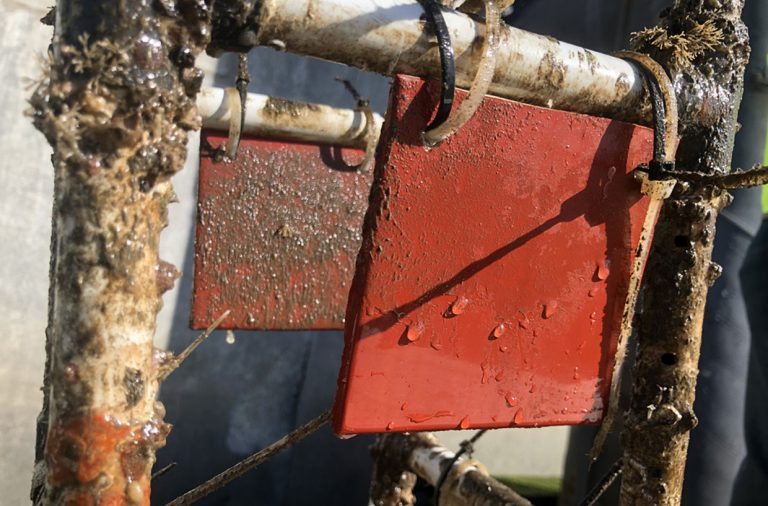
The researchers say that the peptide-based biocide derived from marine cyanobacteria, already tested in real-world environments, has efficacy comparable to, and in some cases even superior to, the biocides commercially used today by the maritime industry.
“By reducing the release of pollutants into the ocean, this technology has the potential to generate clear environmental benefits, but also direct economic gains for sectors such as maritime transport, aquaculture and coastal infrastructures,” declares Joana Almeida.