There is an area in the Atlantic Ocean along the coast of Argentina and Uruguay, known as the Brazil-Malvinas Confluence region, where seven different water masses meet. Each has its own temperature, depth, salinity, nutrients, and their junction makes this one of the world’s richest fishing zones.
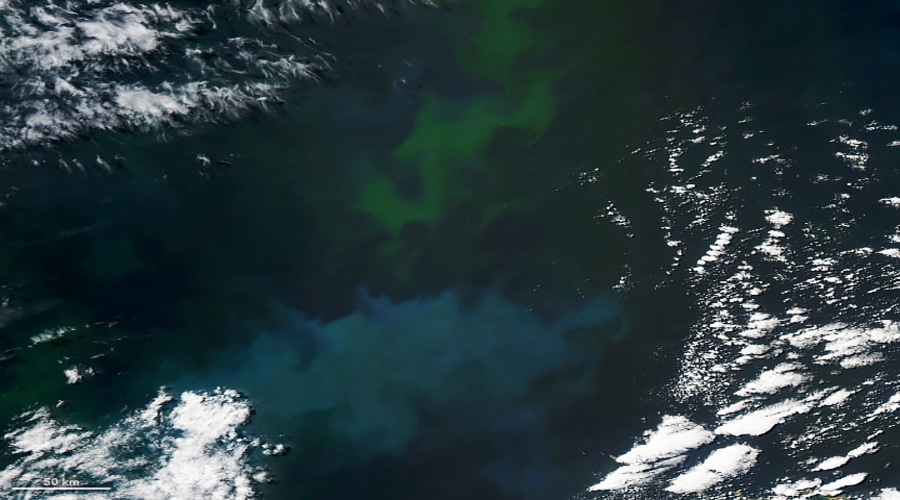
As can be seen in the photograph taken by NASA’s Earth Observatory, at this time of year it is possible to see a large accumulation of phytoplankton, extending for kilometers. This phenomenon is recurring in this region during the Southern Hemisphere summer.
As explained by NASA specialist Michael Carlowicz, although it is difficult to pinpoint via satellite images, the blue patch indicates the presence of coccolithophores, and the green patch the aggregation of diatoms. These marine algae are essential for feeding several species, but also for oxygen production and for sequestration of carbon from the atmosphere.
“The color patches not only reveal the presence of phytoplankton, but also trace the edges of dynamic eddies and the currents that transport them. Off the coasts of Argentina, Uruguay, and Brazil, the warm tropical currents flow southward and advance into colder currents that flow northward in the Antarctic Ocean”, adds Michael Carlowicz.