The Municipal Water and Sanitation Services of Sintra (SMAS de Sintra) collected, in 2025, around 4,500 tonnes of food scraps, three times the quantity collected during the previous year (2024), which demonstrates the growth of selective separation of bio-waste in the municipality of Sintra, according to a press release.
According to the same source, the organic waste collected comes, on the one hand, from the deposition of green bags, which already mobilizes almost 85 thousand people in the domestic sector and 450 establishments of the Horeca Channel (Hospitality, Food Service and Cafeteria) and, on the other hand, from the exclusive dedicated collection circuit, which covers more than a hundred large public and private entities. The total bio-waste collected in 2025, including food scraps and green waste, reached 19,930 tonnes.
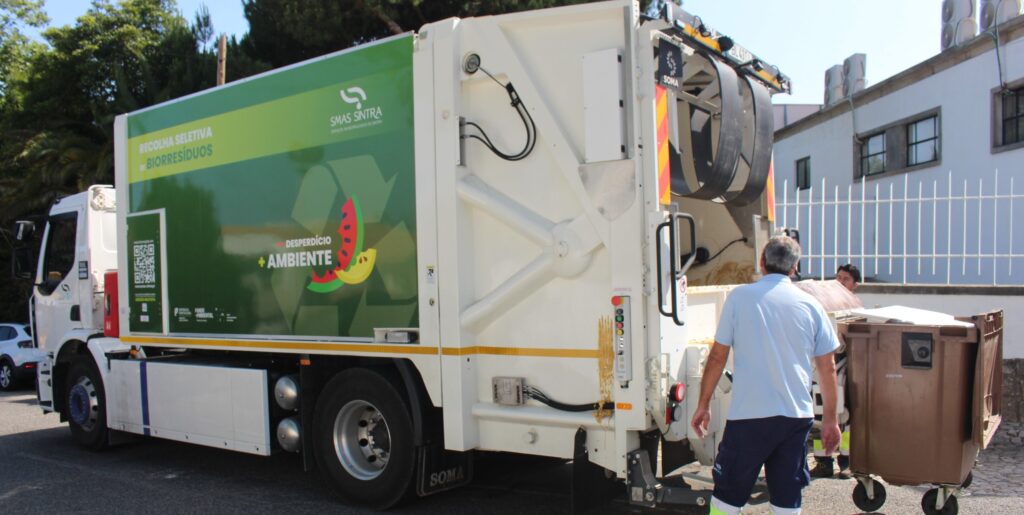
Beyond the significant increase in bio-waste collected through the green bags, from 536 tonnes in 2024 to 3,000 tonnes in 2025, the food scraps collected from large producers, such as companies and schools, also rose from 965 to 1,459 tonnes, to which contributed the reinforcement of the collection fleet with the acquisition of a 100% electric vehicle, representing an investment of 400 thousand euros, financed by the Environmental Fund (Bio Collection Program). The new vehicle allows, in the current year, to increase the number of entities within the circuit, particularly regarding educational establishments.
The vehicle acquired, Renault Trucks D WIDE E-TECH P4X2, is equipped with a bio-waste collection superstructure with a capacity of 16 m3, with equipment for lifting and tipping containers at the rear, and is regarded as a more environmentally friendly vehicle, with zero emissions, thereby reducing the ecological footprint of the organic waste collection operation. The purchase cost of the vehicle, added to the costs of traditional combustion vehicles, is offset by the savings resulting in each collection circuit. In addition to reducing CO2 emissions, the electric trucks are quiet, with benefits for the population during collection operations, as well as for the respective operational team.
For the non-domestic sector, it should be noted, the SMAS of Sintra are adopting two models: on one hand, in a co-collection regime (joint collection of two or more fractions of materials), for catering establishments and similar, with the provision of containers and green bags with a capacity of 20 litres, and on the other, the use of the exclusive circuit with dedicated collection, aimed at large producers of food scraps, such as larger companies, educational establishments, municipal markets and IPSS (Private Institutions of Social Solidarity), where containerisation ranging from 40 to 660 litres has been allocated.
This dedicated circuit, together with the schools, includes various public entities, such as the Sintra and Carregueira prison facilities, the Anti-Air Artillery Regiments (Queluz) and Commandos (Belas) and the Guarda School (Queluz), in addition to other social and educational institutions such as the Association of Parents and Friends of People with Profound Disabilities, Aldeia de Santa Isabel, Casa de Saúde da Idanha, Casa de Saúde do Telhal, CERCITOP, Colégio do Ramalhão and Cardeal Cerejeira Foundation. It also includes larger companies, such as Adreta Plastics, Essilor, Estevão Luís Salvador, Mercedes-Benz and Würth, which are part of this circuit, which also covers the Pestana Sintra Golf Hotel (Beloura), Vila Galé Sintra Hotel, Aldi supermarkets and McDonald’s establishments.
In the domestic sector, in turn, the SMAS of Sintra provide free small containers with a capacity of 7 litres, and green bags, for deposition of the food scraps in the residual waste container. The separation of bio-waste, properly packaged in the green bags, is carried out at Tratolixo’s facilities (inter-municipal company responsible for treatment in the municipalities of Sintra, Cascais, Oeiras and Mafra), diverting these wastes from landfill and enabling their valorisation for energy production and compost for the fertilization of agricultural soils.
With about 85 thousand people mobilized for source separation of food scraps, the SMAS of Sintra maintain, in 2026, the granting of a discount of €2/month to members of the system, within the framework of the water services tariff, with renewal through the request for reinforcement of green bags every six months. A discount that is seen as an incentive to join the Bio-waste Selective Collection System which, in Sintra, was extended to the entire territory of the municipality in October 2022, after a pilot project carried out in the parish of Rio de Mouro, at the end of 2020, then under the motto “Bio-Resources – Too good to waste!”.