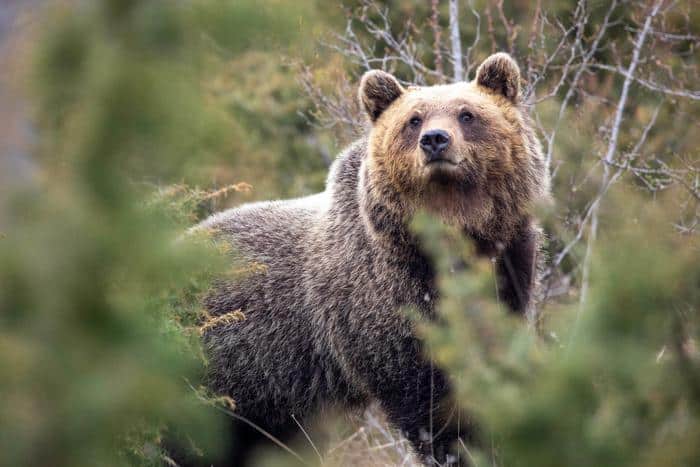
The bears of a small, isolated population living near villages in central Italy have, over the years, become smaller and less aggressive.
This is the conclusion of a paper published this December in the journal Molecular Biology and Evolution, which centers on a subspecies of brown bear, Ursus arctos marsicanus, found only in the Apennines and with a long history of proximity to the human communities that also live there.
Researchers say that human-caused environmental changes have major impacts on wildlife, often leading to declines in animal populations or imposing pressures that affect how a given species evolves. Could this be the story of the bears in that Italian region?
It is estimated that the ursine subspecies diverged from the European brown bear (Ursus arctos) 2,000 to 3,000 years ago, having been completely isolated from other bear populations for at least 1,500 years.
“One of the main drivers of the decline and isolation has probably been deforestation linked to agricultural expansion and the rise in population density in central Italy,” explains, in a statement, Andrea Benazzo, a researcher at the University of Ferrara and coauthor of the study.
Since then, the Apennine brown bears seem to have followed a different evolutionary path. Today, compared with other brown bear populations in Europe, North America and Asia, they have smaller bodies, distinctive heads and facial features, and are less aggressive.
Based on genetic analyses, the team found that the Apennine bears possess traits associated with a reduced level of aggressiveness, which they speculate may be linked to the removal of more aggressive bears by humans over time. In this way, only the less aggressive ones remained, shaping the genetic makeup of the current population.
For Giorgio Bertorelle, the lead co-author of the study and also a researcher at the University of Ferrara, the implications of the study’s results “are clear.” He argues that interactions between humans and wildlife can often jeopardize a species’ survival, but he notes, “they can also foster the evolution of traits that reduce conflict.”
“This means that even populations that have been strongly and negatively affected by human activities may contain genetic variants that should not be diluted, for example, by restocking,” he notes.