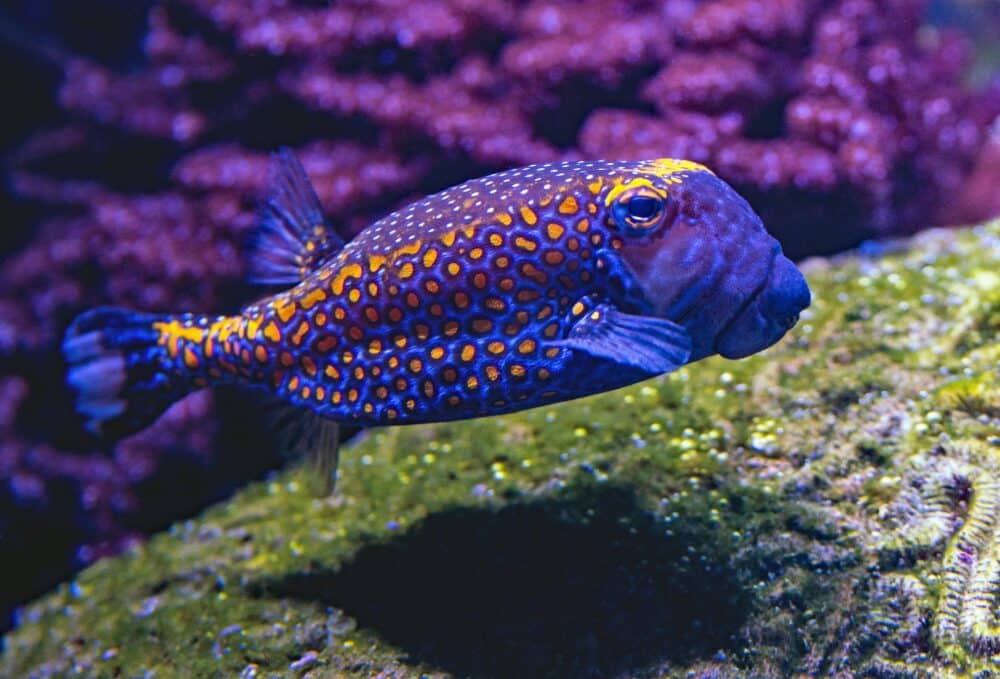
Surely many readers will already have seen, in aquariums or in the sea, fish that “hover” in the water column, motionless, yet not being swept by the current and maintaining their position with their belly facing downward.
For a long time it was believed that this behavior was a way for fish to rest, conserving energy. However, a new study reveals that the effort required to maintain a stationary position is far greater than previously thought.
To stay in the same place when suspended in the water, fish have to flap, albeit sometimes imperceptibly, their fins to counteract the forces of the current and gravity. If they did not, they could be forced to rotate about their horizontal axis, ending up on their side or even on their belly.
In an article published in the journal PNAS, an international team of scientists calculates that hovering fish spend twice as much energy as when they are resting, in rock crevices, among algae, or on the sand in some safe refuge.
The researchers say this is true even for fish with swim bladders, an organ that contains water and gas that allows them to control the depth at which they swim without sinking or being carried to the surface. If they did not constantly flap their fins, even these animals could be swept by the current or roll over onto their sides.
To reach this conclusion, the researchers studied 13 species of fish with swim bladders and, in the laboratory, measured the oxygen consumption of the animals during hovering and when they were resting on the bottom of the tank.
Using high-speed cameras, the team was able to document the movements of the fins when the fish were suspended in the water.
Valetina Di Santo, from the Scripps Institution of Oceanography (United States of America) and the first author of the study, explains, in a press release, that the act of “hovering” is the equivalent of a person trying to balance on a stationary bicycle. Anyone who has tried it knows that you need to lift your feet off the pedals frequently to avoid tipping over. Something similar happens with fish.
The scientists say that the effort required not to roll over results from the instability caused by the fact that the swim bladder and the fish’s center of mass are not perfectly aligned with one another. This creates a tendency to roll, forcing the fish to make constant adjustments with their fins to maintain their position.
The location of the fins on the body also influences how much energy is spent to “hover.” According to the researchers, fish with pectoral fins located further back generally achieve greater stability with lower energy costs. In addition, body type also matters.
Slimmer and longer fish need to spend more energy to maintain their positions when suspended, while those with sturdier bodies, such as pufferfish and goldfish, can do so more efficiently.
Thus, although longer and slender fish may be capable of faster maneuvers in the water, they must expend more energy to stay “hovering.” Larger and more compact bodies are less maneuverable, but they make up for it, at least in terms of maintaining a stationary position.