The migratory aquatic birds that travel to the Arctic to breed have some capacity to anticipate their long journeys to coincide with the increasingly early arrival of spring at the Earth’s North Pole. However, there are limits.
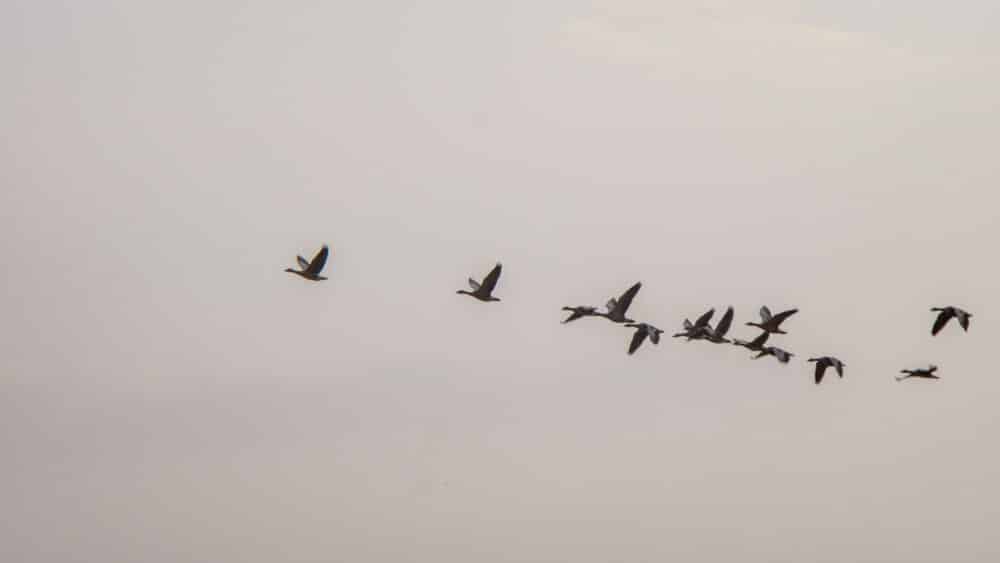
In an article published in the journal ‘Nature Climate Change, more than two dozen scientists tracked, via GPS, the migrations of five species: the dark-bellied brent goose (Branta bernicla bernicla), the white-fronted goose (Branta leucopsis), the greater white-fronted goose (Anser albifrons), the short-billed goose (Anser brachyrhynchus) and the Bewick’s swan (Cygnus columbianus bewickii).
The team found that these birds are capable of reducing the time they spend feeding, and stocking their energy and fat reserves in preparation for migration, and, in this way, launching themselves into the skies earlier to reach the Arctic as early spring begins to bloom.
“Our results are both encouraging and worrying,” admits, cited in a press release, Hans Linssen, from the University of Amsterdam and the study’s lead author.
“We show that these birds can migrate more quickly by adjusting the stopovers they make and the feeding times,” the researcher explains, but warns that this flexibility will only be advantageous “for a few more decades,” specifically between 18 and 28 years. After that, advancing migrations, by themselves, will not be enough.
This is because the birds need to be well fed before travelling thousands of kilometres to the Arctic, and that requires stopovers along the way to rest and recover energy. Moreover, to depart earlier and align their arrival with springs that are becoming increasingly early due to climate change, the birds need high-quality food and favorable conditions, which does not always occur.
Therefore, it is possible that many birds end up arriving at the Arctic in poor health, which could affect their reproduction and, ultimately, the future of their populations.
“These birds are showing incredible adaptability,” says Linssen. “But by mid-century, they will need other strategies, such as changing their wintering grounds or completely altering migration routes, to stay synchronized with Arctic spring.”