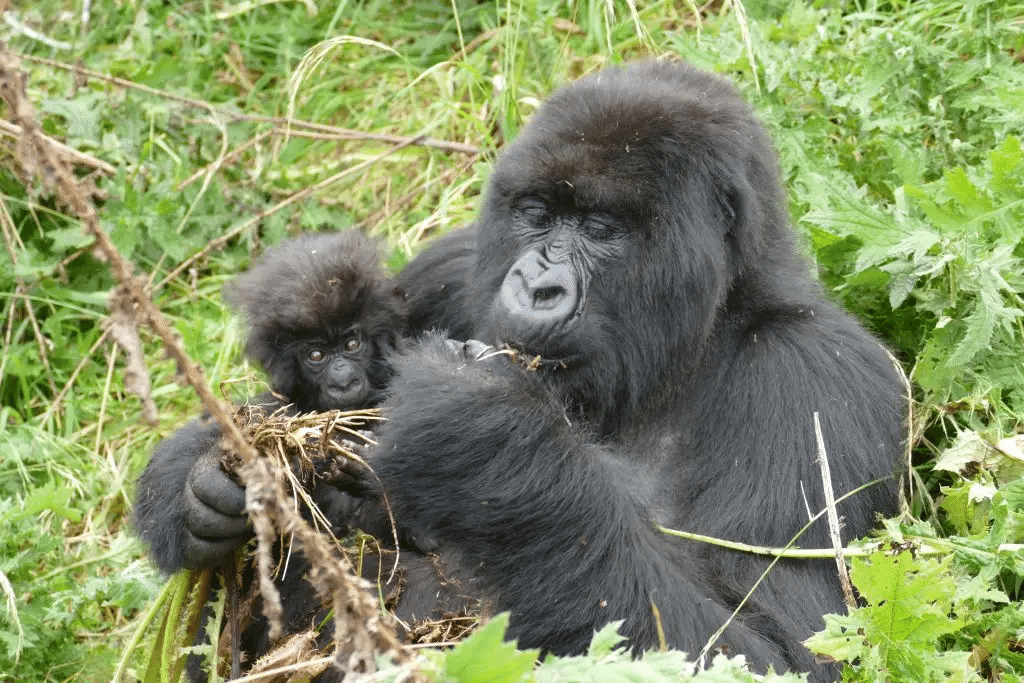
Like humans, even before long-distance trade networks existed, the gorillas’ diet depends on what is available in the areas where they live.
A team of scientists, led by the Dian Fossey Gorilla Fund, studied the diets of 12 groups of mountain gorillas (Gorilla beringei beringei), a subspecies of the eastern gorilla (Gorilla beringei), living in Volcanoes National Park, in Rwanda. Eight groups live in the park’s southwestern part, between 2,600 and 3,800 meters above sea level, while the remaining four reside in the northeast, between 2,400 and 2,800 meters.
In a paper published in the journal Ecology and Evolution in May, which we highlight to mark International Gorilla Day, celebrated on September 24, the researchers reveal a great variation in the diets of these gorillas, even when they live only a few kilometres apart.
The objective was to determine whether differences in the altitude they live at and the vegetation present influence what these great apes eat and whether variations in the quality and quantity of the ingredients ingested can help explain why some groups grow more quickly than others.
Results, obtained through direct field observations and the analysis of the nutritional values of the plants consumed, show that, although the two gorilla sets have almost entirely distinct diets, the nutritional value of what they eat is similar. The researchers say that the diets of the groups living in the park’s eastern region tend to be more varied than those of the western subpopulation.
However, and despite these nearly complete differences, only one plant type is consumed by both: bamboo, which constitutes what the scientists call a “key food,” since it represents an important part of the diet of these non-human primates. Still, they warn, recalling previous studies, that bamboo is not regenerating as frequently as in the past, probably due to reduced rainfall during the growth periods of these plants.
The authors of this study understand that the decline in bamboo abundance in Volcanoes National Park could have impacts on the health and reproduction of mountain gorillas.
Living in an area of only 160 square kilometres, “it is remarkable to see how much dietary variation exists in a population that lives in such a small area,” says Honorine Ihimbazwe, the paper’s first author, quoted in a press release.
The Dian Fossey Gorilla Fund researcher also notes that the mountain gorillas living in Volcanoes National Park are among the most studied animal populations in the world, “and, until now, we had not fully realized that there were these extreme differences in their diet.”
Gorillas living in the park’s western region have been increasing in number more rapidly than conspecifics residing in the eastern areas. Since no differences in the nutritional value of what they eat have been identified, even though their diets are very different, scientists believe that other factors may be at play. For example, they suggest that the distances the primates must travel to obtain food, which is the case for the eastern groups, may lead to greater energy expenditure and thus affect the growth of subpopulations over time.
“These results emphasize the need for locally targeted conservation strategies,” argues Didier Abavandimwe, co-author of the paper.
“As climate change and human pressures alter their environments, understanding how gorillas use their habitats and manage to adapt their behavior is more important than ever,” he notes.