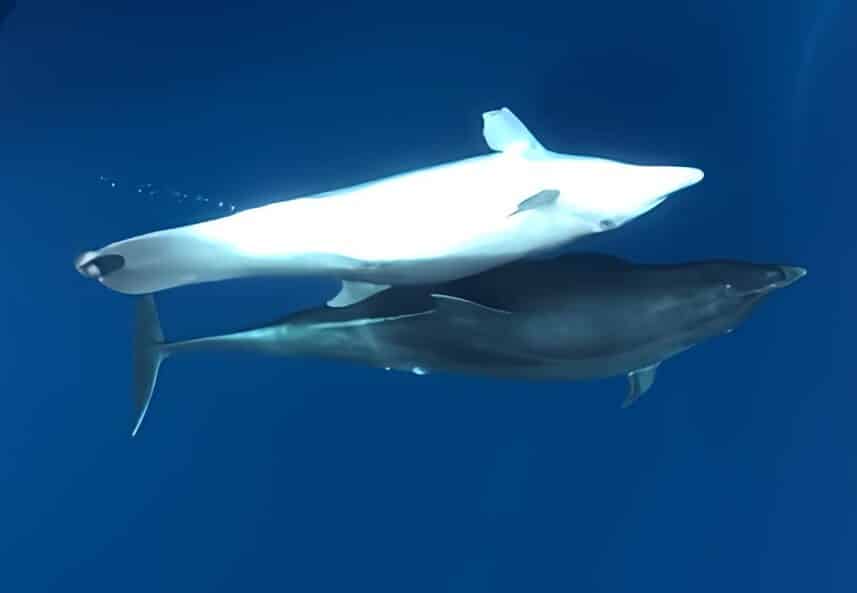
A roaz (Tursiops truncatus), a male, approximately six years old, lived for more than two of those years without the tail fin and with the right pectoral fin partially amputated.
The animal in question was first sighted on 12 October 2021 in the western Mediterranean, about nine kilometres off the coast of Valencia, in Spain. One of the members of the group of bottlenose dolphins that approached the recreational boat from which photographs and videos of the cetaceans were captured showed signs of severe scoliosis, with a large deformation of the spine.
Another member of the group did not have a tail fin, and the right pectoral fin appeared not to be whole. This is the subject of a study published this year in the journal Aquatic Mammals, the result of an investigation led by the Cavanilles Institute of Biodiversity and Evolutionary Biology (Spain).
The tailless dolphin was observed again on 12 August 2023 and, less than a year later, on 26 April 2024, washed ashore, lifeless, on Nules Beach, in Valencia.
“It is a mystery how this dolphin managed to survive for so long,” says Francisco Javier Aznar, the lead co-author of the study. The feat is truly remarkable, since the absence of the tail fin and the right pectoral fin should have greatly limited its ability to swim and hunt.
Nevertheless, the necropsy performed on the dolphin’s carcass revealed that its last meal had been fish and cephalopods of commercially valuable species. Therefore, Aznar argues that after the mutilation the dolphin may have begun to prefer feeding on fish caught by human fishing or on discarded remains.
“Nevertheless, we do not rule out that it may have been assisted by conspecifics, especially its mother, if it still had a close connection with her,” notes the researcher.
Without the tail fin to help it swim, the dolphin tried to adapt: instead of moving its tail up and down, as other cetaceans do, it began moving it from side to side, like a crocodile pushing itself through the water.
It is suspected that the mutilations were caused by the animal becoming entangled in a fishing net. Despite all the trials, the roaz, at the time of the necropsy, appeared in good physical condition and was even above the weight expected for an animal of its size.
However, the end of this animal’s story was, like many others, tragic. Although it had previously managed to escape an encounter with a fishing net that could have been fatal and adapted to its motor limitations, the animal ultimately died by drowning precisely because it had become entangled in another fishing net.
The authors of this study say that this case is but one of many that shows the impact of fishing on marine species such as dolphins, which are often observed interacting with fishing activities off Valencia, “making them particularly vulnerable to bycatch.”