An unprecedented archaeological excavation in a cave on the Indonesian island of Sulawesi could help answer one of the great questions of human evolution: did Homo sapiens live alongside an archaic, now-extinct human species in this Southeast Asian region more than 65 thousand years ago?
The hypothesis is advanced by an international team of archaeologists after several excavation campaigns in the limestone cave of Leang Bulu Bettue, located in the karst region of Maros-Pangkep, in southern Sulawesi. If a temporal overlap between our species and another type of hominin is confirmed, it would also open the possibility of contact and interaction between the two.
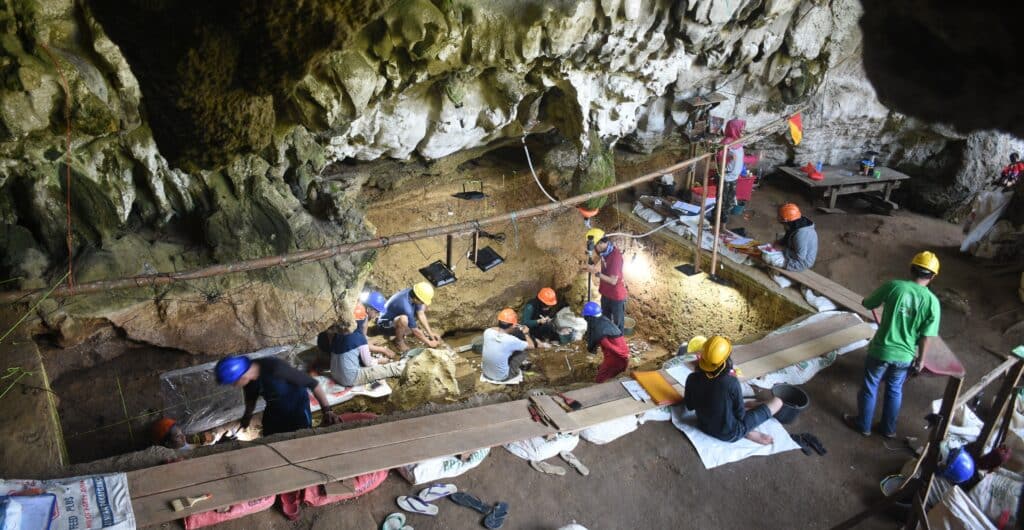
The new study, led by Griffith University and published in the scientific journal PLOS ONE, reveals for the first time a deep and continuous sequence of archaeological deposits that extend eight meters below the current surface. These layers preserve evidence of human activity far earlier than the arrival of Homo sapiens on the island.
The findings reinforce conclusions of an earlier work by the same team, published in Nature, which demonstrated the presence of archaic hominins in Sulawesi at least 1.04 million years ago. In contrast, modern humans are estimated to have reached the island shortly before the initial colonization of Australia, around 65 thousand years ago.
“The depth and continuity of the cultural sequence at Leang Bulu Bettue now place this cave as a reference site to investigate whether these two human lineages coexisted in time,” says Basran Burhan, a southern Sulawesi archaeologist and doctoral student at Griffith University, who led the study under the supervision of Professor Adam Brumm of the Australian Centre for Evolutionary Biology (ARCHE).
The excavations, ongoing since 2013 and funded by the Australian Research Council and Griffith University, revealed an exceptionally long and well-preserved record of human occupation. The deepest and oldest evidence dates to a period earlier than 132 thousand to 208 thousand years ago.
Among the most remarkable findings of this initial phase are evidence of animal butchery and the production of stone tools, including robust implements known as “pickaxes,” all made long before our species left Africa.
“These activities appear to correspond to a cultural tradition of archaic hominins that persisted in Sulawesi until a late phase of the Upper Pleistocene,” explains Adam Brumm. “However, around 40 thousand years ago, the archaeological record shows a dramatic shift.”
An older phase of occupation, characterized by simple core-and-flake technologies and faunal remains dominated by endemic dwarf bovids (anoas) and straight-tusked Asian elephants, extinct today, was replaced by a new cultural phase.
“This more recent phase presents a distinct technological toolkit and the earliest known evidence of artistic expression and symbolic behavior on the island — features associated with modern humans,” says Basran Burhan.
According to the researchers, this behavioral shift may reflect a major demographic and cultural transition in Sulawesi, associated with the arrival of Homo sapiens and the replacement of earlier human populations.
The team argues that Leang Bulu Bettue could provide the first direct archaeological evidence of a chronological overlap — and possibly interaction — between archaic humans and modern humans in the Wallacea region.
The findings underscore the crucial importance of Sulawesi for understanding human evolution in insular Southeast Asia and open new perspectives on how different human species coexisted, adapted, and ultimately disappeared.
“That is what makes archaeological research in Sulawesi so exciting,” says Adam Brumm. “In Australia, no matter how deep you dig, you will never find human occupation before our species. In Sulawesi, by contrast, hominins existed for a million years before we arrived.”
And the story may be far from complete. The investigators have not yet reached the base of the cave’s cultural deposits.
“There may be several additional meters of archaeological layers below the deepest level excavated so far,” Basran Burhan notes. “Future work could bring discoveries that significantly change our understanding of human history on this island — and perhaps beyond it.”
Read more