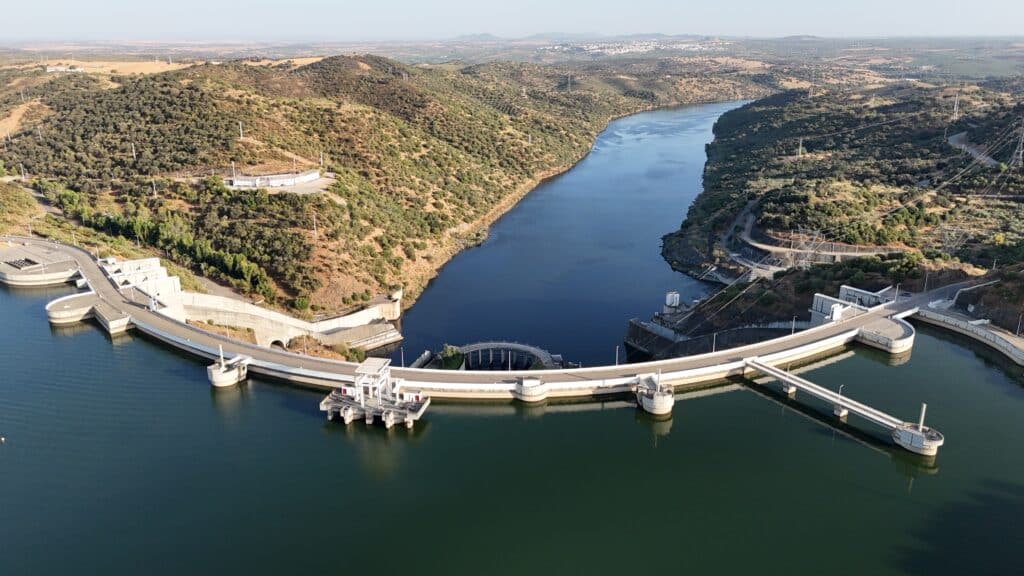
The Government approved a new strategic framework for the management of the Alqueva Multi-Purpose Project (EFMA) in Alentejo, which increases the usable water volume for agriculture, public supply, and industry.
In a statement released today, the Ministry of Agriculture and the Sea notes that this new framework “increases the volume of usable water for agriculture, public supply, and industry, while strengthening the environmental protection of the Guadiana River and the system’s resilience in the face of water scarcity.”
Emphasizing that new rules were decided to “adjust the operation of the system to climatic and territorial challenges in the South of the country,” the ministry also recalls that on Wednesday, in the Diário da República, a joint order from the Ministries of Environment and Energy and of Agriculture and the Sea determines the revision of the EFMA operating regime and the contracts associated with the Alqueva-Pedrógão system in the Beja district.
According to the two ministries, the Government thus adjusts these systems “to the challenges of climate change, to the growing demand for water, and to the environmental and international commitments Portugal has undertaken.”
“In the scope of this decision, the maximum annual volume of water allocated to the different uses rises from 620 hm³ [cubic hectometers] to 730 hm³ per year, corresponding to an increase of 110 hm³, of which 100 hm³ is for agriculture and 10 hm³ for public and industrial supply.”
The new strategic framework also provides for the use of “690 hm³/year for irrigation and 40 hm³/year for public and industrial supply, allowing to respond to the high uptake of irrigation, urban and industrial demand, and the region’s sustainable development.”
According to the Government, “this strengthening of water availability is subject to rigorous hydrological criteria, the existence of contingency plans for drought situations, and the maintenance of a permanent reserve of 120 hm³, intended to guarantee up to three years of urban consumption, ensuring water security in adverse climatic scenarios.”
Cited in the press release, the Minister of Environment and Energy, Maria da Graça Carvalho, stated that “this review marks a structural turning point in Portugal’s water policy.”
“O Alqueva has to continue to be a driver of development in Alentejo, but also an example of responsible water governance,” she stressed.
For his part, the Minister of Agriculture and Sea, José Manuel Fernandes, underscored that, with this decision, “the stability of investments already made is guaranteed and the conditions necessary to host new projects have been created.”
The minister added that the new regime “allows taking Alqueva’s water further, without giving up the efficient and responsible use of water resources.”
In the press release, the two ministries indicated that the new framework also strengthens “the requirements for monitoring and governance of water.”
In this regard, they added, the Alqueva Development and Infrastructure Company (EDIA), in coordination with the Portuguese Environment Agency (APA), “will ensure weekly and automatic reporting of the volumes stored and transferred between the system’s reservoirs, increasing transparency and public control of water management.”
The order also determines the development “of studies and projects for the installation of new infrastructures to regulate ecological flows in Guadiana tributaries downstream of the Pedrógão dam.”
Also planned are “the promotion of studies for interconnection” of the Monte da Rocha reservoir, in the municipality of Ourique, with Santa Clara, in the municipality of Odemira, “strengthening the system’s capacity to respond to extreme climatic variability.”
In the press release, the environmental and energy ministries and the agriculture and sea ministries also revealed that a “long-term environmental program for the Guadiana estuary” will be created.
The order also requires that EDIA, in coordination with the APA, present to the Government, “within six months,” proposals to amend the operating contract of the Alqueva and Pedrógão hydroelectric plants and the sub-concession contract of the public water domain.