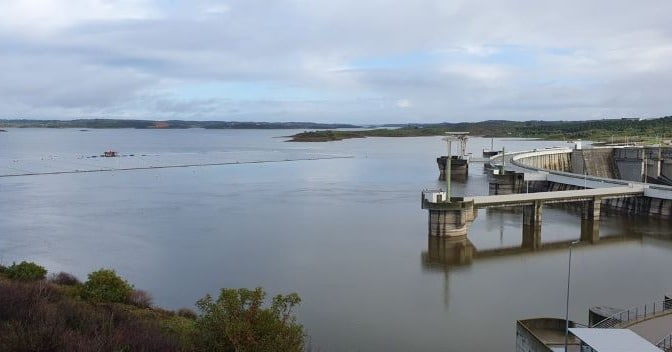
The municipalities surrounding the Alqueva reservoir welcomed the ‘green light’ to draft a new territorial management program for the area of this reservoir, which would allow better exploitation and tourism development, but always with rules.
“Several years, quite a few, have already passed without the plan being revised,” and “there was every need to proceed with its revision [to] respond to the expectations of the municipalities themselves in the Alqueva surrounding area,” stressed Maria Luísa Farinha, president of the Portel City Hall in the Évora district.
In statements to journalists, in Reguengos de Monsaraz, the mayor, who is also president of the Transfrontier Association of Municipalities of the Alqueva Lake (ATLA), affirmed that the municipalities expect that the Special Program for the Alqueva and Pedrógão Reservoirs (PEAAP) to ‘alleviate’ some of the constraints experienced over the years.
ATLA is one of the entities that signed today, in Reguengos de Monsaraz, the collaboration protocol to draft the PEAAP, in a ceremony held at the Town Hall and presided over by the Minister of Environment and Energy, Maria da Graça Carvalho.
The protocol relating to the PEAAP, which should be ready within two years and will replace the Plan for the Management of the Alqueva and Pedrógão Reservoirs (POAAP), also involves the Portuguese Environment Agency (APA) and the Alqueva Development and Infrastructure Company (EDIA).
Maria Luísa Farinha recalled that, over the years, “it has always been a demand and a struggle” by the municipalities to revise the POAAP, whose last version dates from 2006 and which should have been the subject of a revision, which never materialized.
“At this moment, [the POAAP] did not provide answers to the real needs of the territory,” so the municipalities expect that the new special program will allow “to better explore the area around the banks” and enable “more access and the creation of other infrastructures” in the lake area, stated the ATLA president.
“But with rules, obviously. There must be rules for water supply, for water reserves, for energy production, for agriculture,” but the municipalities around Alqueva have “a clear bet on tourism” and the POAAP “greatly limited what could and could not be done in terms of tourism,” she argued.
The EDIA president, José Pedro Salema, also told the journalists that the POAAP’s vision is “inadequate” to reality.
“We thought we would have territorial development that did not happen. We imagined, for example, that there would be large hotel complexes, with golf courses and heliports, and all that did not happen. We had a real estate market crisis and those projects disappeared,” he noted.
The current idea for Alqueva involves “much smaller units, small rural tourism” and the current territorial planning plan “does not foresee that kind of thing,” and therefore it is necessary to “imagine new forms of space occupation.”
A regulated occupation, that “does not jeopardize the environment, does not jeopardize safety, does not jeopardize the way of economically exploiting the lake, but that is harmonized with the current times,” defended.
The EDIA official suggested, for example, that the PEAAP allow the creation in this zone of the “natural park of the islands and peninsulas of Alqueva, [because] there is material for that,” and even the occupation of some of the islands of the reservoir: “In the current plan, everything is forbidden, therefore human occupation is not foreseen in any of the 426 islands.”
“It does not make sense, because we know that there are some where there is no problem for people to go there and we should even encourage it,” she argued, also proposing the recovery of properties on lands expropriated by the State to build Alqueva, some of which are located on peninsulas and islands, which could give rise to a shelter network for hikers, on a route around the reservoir.